Showing posts with label Ponderings. Show all posts

Monday, November 9, 2026

Thanksgiving 2026


Thanksgiving 2026

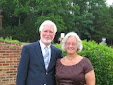
The measure of our marriage


This has been quite the year for us, and while we have been shaken to the core of who we are; our core, our foundation, Jesus Christ, has remained unshaken, steadfast, and our refuge. Life is not touch football, or flag football, life is full-contact football and we all can be blindsided at one time or another.


On the morning of March 30, 2026, at breakfast, Vickie and I were talking about how long our parents and grandparents had lived, and how many more years we might have together, by God’s grace. That very night Vickie was admitted to ICU with a massive bilateral pulmonary embolism, with the right side of her heart shutting down. Do you think there is a lesson here?


With the above as a backdrop, an image recently came to me of our marriage that I’d like to share with you, it is an image of the way we’ve endeavored to live in Christ, and an image of the way I hope we will die in Christ.


Thanksgiving has wonderful memories for us, while also being bittersweet in that my dear brother Jim went to be with Jesus on Thanksgiving as did our beloved friend Gloria. We’ll have a Greater Thanksgiving when we are with them again, never to be parted.


One of our memories, which we were just talking about, was a Thanksgiving in Beverly, MA in which our home was filled with friends from England, Spain, Greece, Germany and the U.S.A.


After the cleanup, after everyone had left, as we were decompressing from a beautiful day, our thoughts turned to that most delicious of delights, turkey sandwiches. After all, is this not why we roast turkeys? Are leftover turkey sandwiches not the true dessert of Thanksgiving? Turkey on white bread with mayo, salt and pepper, and maybe lettuce, and maybe some cranberry. Yes, some may use dinner rolls instead of white bread, that is acceptable, let us not quibble about bread, let us not have schism over bread.


I don’t recall if Vickie or I looked in the refrigerator first; first one of us did, then the other. No leftover turkey. While it pains me, I’ll write it again, no turkey.  As we verified the complete absence of leftover turkey, that delicacy of delicacies, as we discussed the dire situation we were in, we realized what had happened. Between the two of us, we had given all the turkey away as we were distributing containers of leftovers to our dear friends.


All the turkey had been carried out the front door of our home and whisked away to be enjoyed by guests, our friends, our dearly beloved brothers and sisters.


There was not a piece of white meat, not a piece of dark; other than the carcass there was no proof that there had ever been a turkey in our home that Thanksgiving.


We laughed and we are still laughing. We rejoiced, and we are still rejoicing.


Our friends had given us the gift of a loving and memorable Thanksgiving. They had graced our home, petted our dogs, laughed with us, rejoiced with us, bathed us and one another in love and peace – and created a wave of God’s Presence that still carries us along. What is a little turkey among friends?


As Vickie and I approach this Thanksgiving, and as I give thanks for the miracle of Vickie’s healing and recovery – all through the grace of God – (a recent scan showed no evidence that she ever had the bilateral pulmonary embolism, no evidence of the myocardial infarction) – I am reminded that Jesus tells us, “Freely you have received, freely give.”


I am grateful for another Thanksgiving with Vickie (the Lord willing!); I am thankful for every day with her. I am thankful that I am married to a woman with whom I can give all the turkey away. Because you see, our lives are not measured by what we have accumulated, but by what we have given away. They are not measured by what we have experienced, but by what we’ve helped others experience.


My hope is that this will always be the measure of our marriage in our Lord Jesus.


My prayer is God’s blessing on you and yours this Thanksgiving.


Love…much love…


Bob

Friday, October 23, 2026

Tossed – Where Will We Land?


“His winnowing fork is in His hand, and He will thoroughly clear His threshing floor; and He will gather His wheat into the barn, but He will burn up the chaff with unquenchable fire” (Matthew 3:12).


The wheat and the chaff are tossed into the air together and are separated by the wind. The wind carries the chaff away while the wheat falls to the ground and is gathered into the barn. The wheat is thrown into the air just as the chaff, but then the separation – the chaff is carried away.


We ought not to think it strange that we share in the human experience, after all, we are human…though we are now human in Christ. The question isn’t so much about what we experience, but rather how we experience it. Do we experience tossing as chaff or as wheat? The chaff is blown away, the wheat remains.


God says that He will shake all things, so that those things which cannot be shaken may remain (Hebrews 12:26 – 29). We are all tossed, we are all shaken. We cannot avoid being tossed or shaken, the question is whether we will remain – and remain we most certainly will if we are in Jesus Christ.


When we are tossed and shaken our Father will reveal things within us that need to be removed, and He will affirm things within us which we ought to nurture in Christ. Tossing and shaking are opportunities to be transformed into the image of Jesus Christ – opportunities which we ought not to waste.


We cannot permanently insulate ourselves from the suffering common to humanity, sooner or later it will touch us, sooner or later we will face our frailty, sooner or later we will come to the end of ourselves – is it not better to experience this within Christ than to deceive ourselves that we are in control of life? In Christ we can know the security of His embrace, in Christ we can sense His heartbeat for us…outside of Christ we only have a freefall into the abyss.


John’s message is that Jesus has a winnowing fork and is throwing the wheat and the chaff into the air; when Jesus comes into our lives, into our communities, into our churches, He comes with a winnowing fork, He comes to upset us, He comes to toss us up into the air, He picks us up from our comfortable pews and tosses us up, up, up into the air…and then the wind comes…and the wind blows…and the chaff is gone…while the wheat falls back to the ground to be picked up and brought into the barn by Jesus.


Throughout the Gospels Jesus carries a winnowing fork; He carries it into synagogues, He carries it into the Temple in Jerusalem, He carries it by the Sea of Galilee, He carries it in the Decapolis, He carries it before Annas and Caiaphas, He carries it before Pilate and Herod, and He carries it into our lives.


Let us not be surprised when we are tossed into the air by the winnowing fork of Jesus; instead, let us be faithful to Him.


Thursday, September 10, 2026

Two Healings, Two Responses (5)


In our previous reflection I asked how Chapter 10 might relate to chapters 9 and 11. Let’s ponder a couple of intersections; perhaps you will see more for there are many facets in this diamond.


“I am the door; if anyone enters through Me, he will be saved, and will go in and out and find pasture. The thief comes only to steal and kill and destroy; I came that they may have life,  and have it abundantly. I am the Good Shepherd; the Good Shepherd lays down His life for the sheep” (John 10:9 – 11).


When we read Jesus’ words, are we reminded of Psalm 23? “The LORD is my shepherd, I shall not want. He makes me lie down in green pastures”? Perhaps we also recall Psalm 100, “It is He who made us, and not we ourselves; we are His people and the sheep of His pasture.”


Then there is, “Now the God of peace, who brought up from the dead the great Shepherd of the sheep through the blood of the eternal covenant, even Jesus our Lord, equip you in every good thing to do His will, working in us that which is pleasing in His sight, through Jesus Christ, to whom be the glory forever and ever. Amen” (Hebrews 13:20 – 21).


To “see” Psalm 23 is to “see” John 10, and to see John 10 is to see Psalm 23. The Shepherd of Psalm 23 loves and cares for His own by laying His life down for them, we may not see this in Psalm 23 until we arrive at John 10, but it is there. The Shepherd of Psalm 23 can prepare a table for us in the presence of our enemies because He has conquered death, defeated our enemies, and in Him we have nothing to fear (see Hebrews Chapter 2).


One of the points – counterpoints of John’s Gospel is the Good Shepherd caring for His sheep with love and care, drawing them into relationship with Himself; and then the Good Shepherd among wolves, protecting His sheep, eventually being torn and devoured by the wolves for the sake of His sheep. The wolves mock Him, the soldiers take His clothes, His body is entombed – the wolves think they have won. The wolves are fools, the enemy has been broken and doesn’t know it…yet.


In other words, Jesus cares for people and is then attacked, He cares for people and is attacked, He cares for more people and is attacked – we see this in all four Gospels. The Good Shepherd fends off wolves throughout the Gospel. The wolves eventually bring Him into their den (John 18:12 – 13), from their den they bring Him to Pilate, and from Pilate He goes to Golgotha.


The resurrected Shepherd then leads His flock to victory, as we see in Revelation, by teaching them to also lay down their lives for others, by being…as is the Shepherd…both shepherd and sacrifice. The Good Shepherd teaches His sheep to overcome evil with good, to overcome violence with peace, to love in the face of hate, to embrace poverty so that others may have wealth, to die so that others may live.


Can we see that it is the Good Shepherd who anoints the eyes of the blind man in John 9, and who calls Lazarus from the dead in John 11? Jesus calls Lazarus’s name and Lazarus comes forth, for He calls His sheep by name and they know His voice (John 10:3 - 4).


Can we see Jesus shepherding Andrew and Peter, and Philip and Nathaniel in John 1? Can we see Him caring for the people at the wedding in Chapter 2? Can we see Him protecting His sheep from money-hungry wolves in the Temple (cp. 2)?


Do we see Jesus shepherding Nicodemus along in Chapter 3? The woman in Chapter 4? Do we see Jesus attempting to shepherd the sick man by the pool in Chapter 5? Do we see the kindly Good Shepherd feeding the thousands, and bidding them to partake of Him in 6? Jesus is saying, “I have given you loaves and fishes, but I want to give you Myself. You have eaten perishable food, I bid you to eat the food and drink that will abide in you forever.”


But not only does the Good Shepherd walk with the blind man and Lazarus, not only does He care for the sheep of Matthew, Mark, Luke, and John; but He lives and walks among us! He is ever with us, always guiding us, comforting us, listening to us, watching us; and desiring that we would love Him even as He so deeply loves us.


“A am the Good Shepherd, and I know My own and My own know Me, even as the Father knows Me and I know the Father; and I lay down My life for the sheep” (John 10:14 – 15).


Jesus, the Door, is open; we are to know Him “even as the Father knows Me and I know the Father”! O dear, dear friends, can we not leave behind the elementary things of this pilgrimage and press on to know Jesus intimately, and in knowing Him make Him known to those around us? Why, O why, do we lay foundations again and again, week after week, sermon after sermon, lesson after lesson (Hebrews 5:11 – 6:3).


Why do we insist on living in such woeful insecurity, seldom accepting His incredible love and His work of reconciliation and maturity within us? (Hebrews 10:10 – 14).


For the Good Shepherd says to us all, “Even as the Father sent me, I also send you” (John 20:21; 17:13 – 19).


Well, my friends, as Jesus is the Good Shepherd to the blind man and to Lazarus, He calls us to be good and faithful shepherds to those around us, ever and always living in and out from our Great Shepherd of the sheep, our Lord Jesus Christ.


Who are we caring for today?


For whom are we laying down our lives?"

Wednesday, September 2, 2026

All In For Jesus


“The kingdom of heaven is like a treasure hidden in the field, which a man found and hid again; and from joy over it he goes and sells all that he has and buys that field.


“Again, the kingdom of heaven is like a merchant seeking fine pearls, and upon finding one pearl of great value, he went and sold all that he had and bought it.” (Matthew 13:44 – 46).


I have been blessed to know musicians over the years, I don’t mean people who can play instruments, I mean people who play and often write music as their way of life. Musicians live in music and music lives in musicians. I have a neighbor friend, Mike, who is a musician. Mike had a career in the Postal Service, from which he retired; but he has never retired from being a musician – that is impossible; Mike’s soul is in music and music is in his soul.


When Mike and I talk, music is usually a part of the conversation, music can drive the conversation. Mike will talk to me about the composition of lyrics and music, he’ll talk to me about the creative process, he’ll share about what he is working on in his home studio. I am not a musician, but since I have loved music all my life, I love not only listening to Mike and asking questions, but I can usually understand what he is talking about because of my love for music; and also because there is much similarity between music and storytelling, good preaching and teaching, and thoughtful writing. When I am with musicians, I expect them to talk music, that is just who they are…they can’t help themselves.


I had a dear friend who was an artist and a photographer. When we rode motorcycles together he always brought his camera, he was always watching the light and looking for a photo opportunity. He rode in front of me and I rode a safe distance behind him, especially on country roads. I did this because I never knew when he would abruptly stop, grab his camera, and start taking photographs. Light was everything and light on an object or landscape didn’t wait for anyone, it changed by the moment and time was of the essence. If he saw a “shot” he needed to take it right then, not 30 seconds from then.


He rode in front so that I wouldn’t crash into him. He also rode in front so that I wouldn’t keep tooling down the road, leaving him behind, not knowing that he had pulled over to take pictures. When I rode with my friend I knew what to expect, I knew not to be in a hurry, I knew to pay attention to him, I knew we’d likely pull over a few times. I knew this because my friend was an artist and photographer, this is who he was. There are those who take photos for a hobby, then there are those who are artists and photographers.


There are different ways to view the treasure hidden in the field and the pearl of great value, both are like diamonds with facets, the light is refracted and they may catch our eyes differently. Sometimes we can be so concerned about not reading something the “wrong way” that we never read it any way, we never enter into it and allow it to enter into us.


Let’s learn to ask ourselves, “What are the possibilities here? How is the light catching me? What am I seeing in this moment?”


Can we see Jesus giving Himself for the field, for the world (Matthew 13:38)? Can we see Jesus giving Himself completely for His Bride, the pearl of great price? Can you see Jesus giving Himself for you, can you see yourself as His treasure?


Can we also see our own lives and our response to Jesus? Note that in both stories the people sell all that they have to obtain the treasure. Whether we see Jesus or ourselves in these stories, the core of them both is the selling of all to obtain the treasure; the core story is an overriding passion and commitment to obtain the treasure at the cost of everything else.


Jesus gave His all for us, and we are called to give our all for Him and for others. Unreserved surrender to Jesus, unreserved commitment to Him, is our calling, our purpose, our destiny.


It is not a matter of Jesus being a part of our life, it is a matter of Jesus being our life. If a musician’s life is music, how much more ought our life to be Jesus?


“He who eats My flesh, and drinks My blood abides in Me, and I in Him” (John 6:56).


Consider that Jesus says, “No one, after putting his hand to the plow and looking back, is fit for the kingdom of God” (Luke 9:62).


“If anyone wishes to come after Me, he must deny himself, and take up his cross daily and follow Me” (Luke 9:23).


Can we find anywhere where Jesus says, “Ease into discipleship. Take your time and test the waters, carefully wade out into the depths of commitment to me.”?


When the man found the treasure hidden in the field he sold all he had to purchase the field. When the other man found the pearl of inestimable value he sold all that he had…and he did it right then…and bought the pearl!


Suppose after the purchase of the pearl his friends saw him and asked, “Where is your house? Where are all the nice things you had? Where is your ornate chariot? Where are your fine wall hangings? Where are your works of gold and silver and precious stones? Where is your stable of racehorses? Aren’t you dining with us tonight in your favorite five-star restaurant? Where is your wealth, where is your treasure? You had so much, where did it all go? Where are all the many pearls you used to have?”


The Scripture says, “He went and sold all that he had.”


Let us be honest, are we not like the disciples crying, “Why this waste?” (Matthew 26:6 – 13). What is the sense of taking everything we have and everything we are and pouring it out on Jesus? Is it not a waste? Does it not make better sense to give Jesus a little, as much as circumstances warrant, and keep the rest for ourselves (of course we tell ourselves that we are “stewards”)? After all, we can give Him everything in eternity, can we not?


Is not single-hearted devotion to Jesus Christ a bit unreasonable? What would people think?


Are we “all in” for Jesus as Jesus was “all in” for us?


One of my fondest memories is of our visits to the saints in Warrenton VA many years ago. The songs sung were accompanied by the flutter of angels’ wings and, it seems to me, heavenly voices. This particular song has remained with me over the years, and I think I’ll close with it:


YOU FILL UP MY SPIRIT

(to the tune of John Denver’s Annie’s Song)


You fill up my spirit

As I stand here inside You

And call on Your name,

You come and You love me,

You’re my joy

and my sorrow,

I sit in Your presence

And love you again.


My Jesus, I love You.

I will always be with You.

Let me cry in Your presence,

Let me die in Your arms.

It’s all my desire

To give my life to You.

You fill up my spirit,

I’m Yours evermore.


(This can also be sung in the plural – we/us).

Monday, August 31, 2026

Two Healings, Two Responses (4)


I want to touch on a similarity between Jesus healing the blind man in John Chapter 9 and His raising Lazarus from the dead in John Chapter 11.


“His disciples asked Him, ‘Rabbi, who sinned, this man or his parents, that he would be born blind?’ Jesus answered, ‘It was neither that this man sinned, nor his parents; but it was so that the works of God might be displayed in him’” (John 9:2 – 3).


“The sisters sent word to Him, saying, ‘Lord, behold, he whom You love is sick.’ But when Jesus heard this, He said, ‘This sickness is not to end in death, but for the glory of God, so that the Son of God may be glorified by it’” (John 11:3 – 4).


Jesus points us to the glory of God as the purpose for the condition of the blind man and the condition of Lazarus. Now for sure, we might ask whether it was necessary for the blind man to have been born blind and to have lived into adulthood in that condition. We might ask whether it was necessary for Martha and Mary to go through the anxiety of Lazarus’s sickness and the sorrow and grief of his death. We could ask what Lazarus thought and felt about the whole experience.


It might be easy for some of us to say, “Such questions are not appropriate, if Jesus said it was necessary then that is the end of the matter.” Others might say, “Why? Why was it necessary for the man to be born blind and for Lazarus to die? Were there no alternatives? What other possibilities were there?”


Perhaps we can look to the difference between Zacharias and Mary for wisdom. When Zacharias hears Gabriel’s incredible message he responds in unbelief, “How will I know this for certain? For I am an old man and my wife is an old woman” (Luke 1:18).


However, when Mary hears Gabriel’s even more incredible message she responds in awesome wonder and belief, “How will this be, since I am a virgin?” (Luke 1:34)


“Behold, the bondslave of the Lord; may it be done to me according to your word” (Luke 1:38).


Perhaps there is also an element of the father crying to Jesus, “I do believe, help my unbelief” (Mark 9:24).


When we shut our questions down, our perplexities, we deny our humanity and our dependance on Jesus; we are not robots, we have feelings, we have questioning thoughts. It is worse when we try to shut others down, denying them the opportunity to express their struggles, their questions, their search for wisdom and understanding.


On the other hand, playing God, critiquing God’s will and actions and words, engaging in endless “what if” speculation, takes the focus off Jesus and places it on us as the arbiters of life.


Can we trust Jesus or not? Do we trust Him?


Perhaps with the father seeking deliverance for his son we can learn to cry, “Lord, I believe. Help my unbelief!”


We can say, “Lord, I don’t understand all of this. I don’t understand the whys and hows and all the other questions. But I believe You, help me to believe You more and more and to trust You.”


My sense is that faith and belief in the presence of questions and doubt is more precious than a faith which denies the reality of doubt and questions. Let us not pretend; while I imagine that God can work through our pretensions, I sense that He would rather work through our honesty.


I have had friends who have lived and died through much suffering and limitations. I would have been a fool to have said, “This is why this is happening to you. This is why you were born with this disease. This is why this incurable illness has happened to you in the prime of life.”


For sure I saw the glory of God in these friends, for certain they have affected my life in Christ and increased my confidence in Jesus and my vision of eternity; but I simply cannot speculate on why such terrible disease and illness entered their lives, either as children or adults. I must trust Jesus Christ, I must trust His Nature, His Character, I must trust our Good Shepherd.


Let us recall that, “Jesus loved Martha and her sister Mary and Lazarus” (John 11:5).


Jesus loves me, He loves you, He loves us. Nothing can separate us from the love of God which is in Christ Jesus our Lord (Romans 8:29).


Our message can always be, “Jesus loves you and wants to be with you through what you are experiencing. He loves you with every beat of His heart. He wants you to see Him in new ways, ways you never imagined. He wants you to feel His arms holding you close.” We can always have confidence in this Message, for we can always have confidence in Jesus and His love.


This can be our invitation for those who have yet to meet Jesus to meet Him and belong to Him. It can also be our affirmation of God’s love to those who have already come to know Him. We can always trust Jesus…always.


Now for a bit of homework if you please. Between John chapters 9 and 11 is naturally Chapter 10. How might Chapter 10 relate to chapters 9 and 11?


We’ll look at this in the next reflection in this series, the Lord willing.

Tuesday, August 25, 2026

Two Healings, Two Responses (3)


Continuing our comparison between the healings of John 5 and John 9:


In John 9, when Jesus and His disciples see the man born blind, the disciples ask Jesus, “Rabbi, who sinned, this man or his parents, that he would be born blind?”


Jesus replies, “It was neither that this man sinned, nor his parents, but it was so that the works of God might be displayed in him."


In John 5, when Jesus finds the man whom He had healed, He says to him, “Behold, you have become well; do not sin anymore, so that nothing worse happens to you.”


I point out that the subject of sin is raised in both narratives, not to attempt to answer the questions that can be raised in both instances, but because we are comparing the two men, the two healings of Jesus. The Scriptures were not written to satisfy our curiosity; they were written to reveal Jesus Christ. One of my favorite quotes from Fenelon is along the line of, “I know many people who are perfect…in speculation.”


For sure questions can lead us to Jesus, they can cause us to seek, to ask, to knock; and when Jesus is the object of our search and desire that is one thing, however, when our questions do not have Jesus as their object and center of gravity then we often engage in “foolish questions and ignorant speculations” which “produce quarrels” (2 Timothy 2:23).


Furthermore, there are many things deep in the counsels of our Father beyond our understanding; it is not necessary that we know everything, it is necessary that we know Jesus and live in intimate relationship with Him.


Regarding John 9 and the man born blind, one thing we can be assured of, absolutely assured of, is that Jesus always desires to reveal Himself to us, He always desires to display the works of God in us. After all, God so loves us that He gave His only begotten Son for us – of course He wants to reveal Himself to us and draw us ever-closer to Himself.


I often tell folks who in are difficult situations, “I don’t pretend to know why this is happening, why you are going through this, but I do know this, our dear Lord Jesus wants to reveal Himself to you through this and draw you closer to Him.”


I believe this with all of my soul, with all that I am. I believe it because this is the character and Nature of Jesus Christ. There is deep and widespread suffering in this world, few of us escape it, it has many forms, some easily seen, some we never know about. Jesus walks with us through suffering, He carries us, He invites us to share His sufferings, He invites us to bless others through our sufferings – there are many dimensions to suffering and comfort and our transformation into His image.


And so we learn to look for Jesus in life’s pain and suffering, we look for how Jesus is coming to us and those around us, we seek to see the works of God within suffering, tribulation, uncertainty, within our struggles. O dear friends, this life will soon be over and the reality of eternity will be upon us and we will be within it. Each one of us will have a “last day”, each one of us will have a coming of the Lord, each one of us will leave this temporal life and move (actually we’ll “be moved”) into a life glorious beyond measure. Are we preparing for this? Are we allowing Christ to prepare us? Can we smell it? Taste it? Sense it? Touch it? See it, in some measure?


Let us always look for Jesus to reveal Himself.


Then we have what Jesus said to the man in Chapter 5, “Behold, you have become well; do not sin anymore, so that nothing worse happens to you.”


This may remind us of what Jesus says to the woman of John 8:11, “Go and sin no more.” I point this similarity out without further comment.


Regarding the man who had been ill for thirty-eight years in Chapter 5, physical incapacity does not mean that our capacity for sin is lessened (Matthew 5:21 – 30; 12:33 – 37; 15:10 – 20). We do not know how the man lived prior to his prolonged illness, nor do we know how he lived during his illness; we do know that Jesus warned him to stop sinning so that “nothing worse happens to you.”


It appears that this man did not take Jesus’ counsel to heart, for unless he was completely naïve, he must have known the result of telling the religious leaders that it was Jesus who healed him on the Sabbath. The man of John 9 aligned himself with Jesus, the man of John 5 gave his allegiance to those who sought to destroy Jesus.


Later in John Chapter 5 Jesus asks, “How can you believe, when you receive glory from one another and you do not seek the glory that is from the one and only God?” This is the way of the religious world as much as it is the way of the world. It is often the way of those “searching Scriptures (John 5:39). Thankfully, we also have Bereans in our midst (Acts 17:11)!


Have I ever betrayed Jesus to the world or to the Pharisees? Have I received the blessings of Jesus, only to align myself with systems bent on His destruction? When others have asked me the equivalent of, “Why are you carrying your pallet on the Sabbath?” have I blamed Jesus and betrayed Him, rather than, like the man of John Chapter 9, steadfastly testified of Him and worshipped Him, have I been willing to be “put out” (9:34)? (See also Hebrews 13:13).


There is no peer pressure quite like religious peer pressure.


I will keep my answers to myself, for they are not pretty answers; my answers shock me, they shame me, they make me tremble.


What about you?

Wednesday, August 19, 2026

Two Healings, Two Responses (2)


Continuing our reflections on the healings of John chapters 5 and 9:


In both instances, the Pharisees challenged the men healed. In Chapter 5 they wanted to know why the man was carrying his pallet on the Sabbath. In Chapter 9 the Pharisees challenged the man by saying that the man who healed him, Jesus, was not of God and was a sinner (9:19, 24, 31). This is along the line of what we see earlier in Jesus’s ministry, when the scribes from Jerusalem were saying of Him, “He casts out the demons by the ruler of the demons” (Mark 3:22). That is, the religious leaders were attributing the works of God to Satan and saying that Jesus had an “unclean spirit,” a perilous practice indeed (Mark 3:28 – 30)


Put more bluntly, in John Chapter 9 the Pharisees were telling the man whom Jesus healed, “An ungodly man healed you. God did not heal you. You have been touched by a demon.”


Now then, if you were the blind man, how would you have liked to hear that?


In Chapter 5, when asked by the Pharisees, the man did not know who healed him (5:13). In Chapter 9 the man knew who Jesus was, “The man who is called Jesus made clay, and anointed my eyes…”


There seems to have never been any doubt about Jesus by the man healed of blindness; his understanding of Jesus blossoms in the narrative. He goes from considering Jesus a prophet (9:17) to believing in Jesus as the promised “Son of Man” and worshipping Him (9:35 – 38; Daniel 7:13 – 14; Luke 22:66 – 71).


On the other hand, the man healed in John Chapter 5 shows no thankfulness toward Jesus. Unlike the man born blind, instead of giving Jesus glory he reports Jesus to the religious leaders. After later encountering Jesus in the temple, “The man went away, and told the Jews that it was Jesus who had made him well. For this reason the Jews were persecuting Jesus, because He was doing these things on the Sabbath” (5:14 – 16).


[Note: When John uses the term “Jews” in his Gospel, he is typically referring to the religious and civic leaders of the Jews. John himself was a Jew, as were all the apostles, as were most of the people of Jerusalem.]


Perhaps, in comparing the two men whom Jesus healed in John, there is an element of the ten lepers of Luke 17:11 – 19. “One of them, when he saw that he had been healed, turned back, glorifying God with a loud voice, and he fell on his face at His feet, giving thanks to Him.”


In response, Jesus asks, “Were there not ten cleansed? But the nine – where are they?”


Perhaps there is an element of the Parable of the Sower (Matthew 13:3 – 9, 18 – 23)? The man of John 5 is an example of the “seed beside the road” which “the evil one snatches away.” The man born blind is a picture of the good seed bearing much fruit.


Are we thankful for the work of Jesus in our lives? When He answers prayer do we fall on our faces, worshipping Him?


Do we, as the man born blind, testify to Jesus no matter the opposition? Or do we align ourselves – actively or passively – with those determined to destroy Jesus?


What else do you see when you compare these two men?


We’ll pick this back up, the Lord willing.

Monday, August 17, 2026

Two Healings, Two Responses (1)


Have you ever compared the two healings recorded in John’s Gospel? I’m speaking of the man lying by the pool of Bethesda in John 5, and the blind man in John 9.


Both occurred on the Sabbath (5:9; 9:14) in Jerusalem. The fact that Jesus healed on the Sabbath set the religious leaders off, it made them crazy (5:10, 16; 9:16).


Lately, I’ve been wondering about the emphasis the Gospel’s place on Jesus’ healing on the Sabbath. In Mark 3:1- 8, early in His ministry, Jesus heals on the Sabbath in a synagogue and the religious leaders and Herodians conspire “as to how they might destroy Him.” Later in His ministry, in Luke 13:10 – 17, Jesus heals a woman who had been afflicted for 18 years, and once again stirs up religious opposition.


In Luke 13:15, in response to being attacked verbally by the synagogue official, Jesus says, “You hypocrites…” He doesn’t say, “You don’t understand, hang in here with Me and I’ll explain it to you.” He gets right to the point and calls the religious group “hypocrites.” This is a pattern we see in all four Gospels, and it is especially highlighted in the Gospel of John.


This reminds me of Jesus’ approach in His hometown synagogue in Luke Chapter 4 (I recently did a series on this). Rather than take things nice and easy and work into His Message, He gets to the point about who He is (Luke 4:18 – 19) and then throws gasoline on the fire by pointing to God’s working in the lives of two non-Israelites (Luke 4:25 – 27) which so infuriates His hometown neighbors that they try to kill Him.


Why didn’t Jesus spend the first few weeks or months of His ministry playing by the religious and cultural rules, while healing six days a week and not on the Sabbath? Why, early in His first extended sermon does Jesus say, “Unless your righteousness surpasses that of the scribes and Pharisees, you will not enter the kingdom of heaven” (Matthew 5:20)? Why not wait a few weeks or months before confronting the scribes and Pharisees and try to win them over?


From the very beginning of His ministry right up until its conclusion during Holy Week, Jesus is confrontational with the religious establishment; nor is He seeking to persuade people to follow Him, quite the contrary (John 6:60 – 71; 8:31 – 59; Mark 8:31 – 38; Luke 9:57 – 62). He says, in effect, to the people, “Don’t follow Me unless you know what you are getting into. Don’t believe in Me unless you give Me all that you have and all that you are.”


I don’t know the answer to my questions.


There is an adage in pastoral preaching that we are to comfort the afflicted and afflict the comfortable, and while there may be an element of this in Jesus’ approach to ministry, I don’t think it captures the entire picture. One thing for sure, Jesus doesn’t leave any middle ground, He didn’t do it then and He really doesn’t do it now.


Yet, we do seem to be a people of the middle ground, of compromise with the world, the flesh, and the devil; of compromise with money and possessions and marketing and political and economic and social agendas.


I wonder what our own untouchable “Sabbaths” are. That is, what are those things that Jesus dare not touch in our lives and congregations, that are off limits to Him? I can look back and see many in my own life. There must be some in my heart today, dare I ask Him to reveal them to me?


What are the religious (and other) practices and doctrines and traditions that we defend from Jesus?


Yes, the Sabbath is Biblical in that it is in the Beginning (Genesis 2:1 – 3). However, the true Sabbath is Jesus Christ, with all the Sabbaths and Holy Days of the Old Testament pointing to Him, to relationship with Him, to His glorious Person and work (Hebrews Chapter 4; Colossians 2:16 – 17; Matthew 11:28 – 30).


What do you see when you compare the healings of John 5 and John 9?


We’ll pick this back up, the Lord willing.

Tuesday, August 11, 2026

Enigmatic Faith


Good morning dear ones,


Below is a note I wrote to a friend recently, perhaps there is something here for you.


Much love,


Bob


Good morning Friend,


I am reminded of the father who cried to Jesus, “Lord, I believe, help my unbelief!” I have cried this many times and imagine I will do so many more times. What else can we do?


Faith is enigmatic, at least to me. A labyrinth? If we see the labyrinth in Jesus this is not so bad, for even our apparent dead ends are designed to transform us into His image.


Is He not our Good Shepherd? Can we not trust Him? Is this life not a pilgrimage and prelude to our glorious destiny?


Is not He, our dear Lord Jesus who gave His all for us, what matters? Then others? Lastly ourselves?


Could it be that you are already where you desire to be?


I have no doubt that you are in our Father’s House, for only those in His House and Family have the desires, the doubts, the regrets, and despair that you have.


As I said, faith is enigmatic. What can we do but allow the very faith of Jesus Christ to live within us and through us? He is the Vine and we are the branches and as His life flows through us, so His very own faith flows through us. This is why when I read Galatians 2:20 I read it as the dear KJV translators have it, “by the faith of the Son of God.”


As Jesus lives by the Father, so we live by Jesus…yes?


O dear friend, I have many regrets in my life…so very many. Sometimes I look back and think, “How could this be? How could you have done this, thought this, said this?” Then I am consumed by guilt and shame and remorse. It seems the closer I get to eternity the more I see these things. What to do? What can I do but trust Jesus?


And isn’t that what this all comes down to, trusting Jesus? Trusting Jesus no matter how I feel, or how I perform, or how deeply (or not) I understand a matter?


When I draw my final breath in this life, what can I do other than trust Jesus?


As I have said before, on my best days my Father needs to change my nappy; may God never let me lose sight of this truth.


One of the reasons I so look forward to crossing that river between this life and the next, is that my memory will be purged of toxicity, of poison, of regret and remorse, of things which I can’t bear to think of. I don’t say that this ought to be anyone else’s journey, I simply say to you that this is my journey.


Is my faith so weak that I cannot embrace the totality of God’s forgiveness, that I cannot bask in the cleansing of the blood of the Lamb? Again, this is enigmatic to me. Yes, I do bask in the blood of the Lamb, claim it, proclaim it, rejoice in it. But this is, for me, a journey, a process, a climb up Zion’s mountain – perhaps I need to train myself not to look back, not to look down. Ha!


I climb with a limp. I say to Jesus, “Lord, where else can I go? You have the words of eternal life.”


What some may see as my faith, I see as my desperation – for indeed, where else can I go? Where can anyone go?


When Jesus says that we can’t change our hair or height by thinking, He means it. We are so foolish, are we not; to think we are in control…so foolish to think we are in the driver’s seat. So foolish to think we can add a day, an hour, a moment to our lives.


So realizing that I must trust Him is, for me, less a matter of faith than a matter of simple reality – if this is faith, well and good, all I know is that this is the essence of life.


Tom ____ once said to me, “You have a simple faith.” He meant it as a compliment, and I’ll receive that testimony.


O dear friend, what matters to me is less about how I feel than whether others are coming to know Jesus. I have eternity ahead of me in which I will no doubt feel pretty good, but between now and then I need to follow Jesus and share Him with others. We are on a battlefield fighting for the souls of mankind, I don’t want my feelings to be a distraction…and I know they can be…they have in the past, they may be again…but I must live in the Cross of Christ and allow the Cross to live in and through me.


As Bonhoeffer wrote, “When Christ calls a man, He bids him come and die.”


I have a friend in Amelia County who is a flight instructor. He teaches his students to fly by instrumentation, not to look outside the cockpit. He has a hood that he places on students so that they cannot see outside the plane, all they can see is the instrument panel. If they fly by sight in bad weather they may die, suffering from spatial disorientation.


The students may not “feel” great as they learn to fly by instrumentation, but they and their passengers will live. Neither you nor I really want to be passengers on a plane with a pilot flying by his feelings.


I can be a very emotional person. I have a tambourine which I’ve played in many a worship gathering. I can shout, I can run down a church aisle (which I have, even in our Congregational church!), I have danced in worship gatherings…but I know that I must fly by instrumentation…for the fair weather can quicky change…and for the glory of God and the salvation of others I must keep my eyes on Jesus, always on Jesus.


We can’t go back, at least I don’t think so. O I suppose we can go back in terms of obedience (but even there I’m not sure, hopefully we are wiser and more faithful), but in terms of feelings…well…we do change don’t we? We age, we mature, we bruise, we break bones, we have our hips knocked out of joint…we are no longer children, we are no longer young, we are no longer middle aged.


Yet, this can be the sweetest time of life in many ways, not the least of which is sharing the grace of our Lord Jesus with others…and living in anticipation of that great Day which is nearer to us today than it was yesterday…we are ever closer to that City whose Builder and Maker is God.


What shall we say to these things?


If God is for us, who can be against us?


Much love dear friend,


Bob

Monday, July 20, 2026

Jello Molds


Treating the Bible Like Jello


Do we treat the Bible like Jello?


When we read and teach the Bible do we pour the text into our distinctive molds? Do we add fruit to it? How about toppings?


Do we make our own core identity the core of the Bible?


A friend of mine once did a sermon series on “the Presbyterian view of spiritual formation as seen in the Gospel of John.”


I thought, “Really?”


Why not teach the Gospel of John as it is written?


Or, if you have a pastoral sense to focus on spiritual formation in the Gospel of John, then why not simply approach it as, “Spiritual formation as seen in the Gospel of John?”


Do we want our people to be Baptists, Presbyterians, Pentecostals, or Christians? Well, the pragmatic answer is that we want them to be in the mold of our tradition, whatever that might be. Should we want this? I can’t see that we should want it.


Would we not be better Baptists or Pentecostals if we were Christians first – disciples of Jesus Christ first? Men and women and young people being formed into His image first and foremost?


How many treasures of the Word and of Christ Jesus do we miss when we treat His Word as Jello? On the other hand, if we would learn to receive the Word as it is written and made alive by the Holy Spirit, then the possibilities are infinite because of our Lord Jesus is infinite.


My friend was just doing what he was taught, and he was just doing what most of us do…and what most congregations want their pastors to do.


I wonder how many Jello molds I am still using?


Saturday, July 4, 2026

Great Is Diana

 Good morning, there is much I could say, but perhaps not much I should say. 


Much love,


Bob

Great Is Diana of the Americans

Robert L. Withers

Written in January 2020


During the past few years, as I’ve become increasingly concerned about the engagement of professing-Christians in the political melee in the United States, John Newton has become an historical mentor to me in thinking, teaching, and behavior. This mentorship is particularly pronounced in the area of politics and nationalism.


In August 1775, four months after Colonists and British regulars fought at Lexington and Concord, Newton, Anglican priest and author of Amazing Grace, writes to a young friend concerning Britain and the Colonies:


“As a minister and a Christian I think it is better to lay all the blame upon sin. Instead of telling the people Lord North [the Prime Minister] blunders, I tell them the Lord of hosts is angry. If God has a controversy with us, I can expect no other than that wisdom should be hidden from the wise…I believe the sins of America and Britain have too much prevailed, and that a wrong spirit and wrong measures have taken place on both sides because the Lord has left us to ourselves.


“It seems to me one of the darkest signs of the times, that so many of the Lord’s professing people act as if they thought he was withdrawn from the earth…instead of unavailing clamors against men and measures they would all unite in earnest prayer, we might hope for better times, otherwise I fear bad will be worse.”


As the letter continues, Newton turns his attention to the idea of liberty; turning to Jeremiah the prophet Newton writes:


“He [Jeremiah] preached against sin and foretold judgment, but I do not find that he made a parade about liberty…He does not seem to have troubled his head, who was scribe or recorder, or who was over the host [that is, who was in charge of government and the military], for he knew that whoever had the management, the public affairs would miscarry because the Lord fought against them. When I hear the cry about liberty I think of the old cry, ‘Great is Diana of the Ephesians’ [italics mine]. Civil liberty is a valuable blessing, but if people sin it away, it is the Lord [who] deprives them of it…


“However a believer has a liberty with which Jesus has made him free which depends upon no outward circumstances. It grieves me to hear those who are slaves to sin and Satan, make such a stir about that phantom which they worship under the name of liberty, and especially to see not a few of the Lord’s people so much conformed to the world in this respect [italics mine].”


When I first read the above letter, a year or two ago, I was taken with Newton’s image (no pun intended) of Diana of the Ephesians from Acts Chapter 19. A few days ago I realized that Newton’s use of Diana preceded his 1775 letter, for in a 1773 letter he writes to a fellow minister:


“On the other hand, you and I, dear sir, know how much they are to be pitied who are frantic for what they call liberty, and consider not that they are in the most deplorable bondage, the slaves of sin and Satan, and subject to the curse of the law, and the wrath of God. Oh for a voice to reach their hearts, that they may know themselves, and seek deliverance from their dreadful thralldom! Satan has many contrivances to amuse them, and to turn their thoughts from their real danger; and none more ensnaring, in the present day, than to engage them in the cry, ‘Great is the Diana Liberty!’ [italics mine].


“…And already in some pulpits, (proh dolor!) [Latin: oh the grief!] a description of the rights of man occupies much of the time which used to be employed in proclaiming the glory and grace of the Savior, and the rights of God to the love and obedience of his creatures.”


It seems to me that Christian nationalism, and Christian political engagement, whether it be from the “right” or the “left”, or even the “center” – is a snare to the professing-church in that it obscures our witness to Jesus Christ and His Gospel as it exalts our “rights” and “liberties” and “personal freedoms”.


There is a sense in which, for the disciple of Jesus Christ, there is no “personal freedom”, for we are called to be servants of Jesus Christ; indeed, since we have been purchased and redeemed by Jesus Christ, we are no longer our own possession – to echo Paul, we are not our own, we are bought with a price.


The People of God are called to be distinct from the world, the flesh, and the devil. We are called to be distinct from the “right”, the “left”, the “center”; our Gospel is to be for all mankind without regard to ethnicity or national flag or economic system.


We are to discern the difference between the Bible and the constitutions of nations, the political systems of nations, the economic systems of nations, and the foreign policies of nations. If the Gospel of Jesus Christ is transcendent then the Church of Jesus Christ ought to express itself, in Christ, transcendently. How can this be otherwise, unless professing - churches within national boundaries prostitute themselves in the service of the world? Babylon the Harlot rides the beast until the beast destroys her (Revelation Chapter 17). Can we not be a foolish people?


We have been taught to make idols of liberty, prosperity, pleasure, our founding national documents, our foreign policy, our economic policies – and we seek our identity in these things rather than in Jesus Christ. As we fail to be citizens of the Kingdom of Heaven (Philippians 3:20) we fail to be good neighbors to our fellow earthly citizens and neighbors.


When we adopt a faulty sense of our national identity in place of a true sense of “a better country, a heavenly country” (Hebrews 11:16) and we cease to live as pilgrims and strangers we, as Esau, sell our birthright for a mess of pottage; we trade our high calling for short-term pleasure and gratification. We forego identification with the Christ of the Cross and the Cross of Christ for temporal agendas that will turn to dust. The beast will eat us and we are so drunk with the world that we won’t even know it – it devours us even as I write this.


Newton chose Christ above everything. When other ministers of the Gospel attempted to pull him into political and nationalistic orbits Newton resisted, when others appealed to “liberty” Newton recognized the danger of liberty outside of Jesus Christ. Newton saw the that great need of mankind was not political liberty, but rather liberty from sin and death. Newton saw that Christ held him accountable for preaching the Gospel, and that not a day was to be spared in the service of temporal movements outside of the Gospel.


Newton saw that the turmoil of his nation and world could only be the result of sin, and that there is no political remedy for sin.


Lest we forget, Newton was engaged is serving the fatherless, the widow, the hungry, and the slave; the Gospel of Jesus Christ for John Newton included serving the “whole person” – John Newton knew, as we should know, that the only hope for this world was, and is, Amazing Grace.


Wednesday, July 1, 2026

HRH Princess Kate and Knowing Jesus


HRH Princess Kate recently completed the UK’s Three Peaks Challenge, which involves hiking up Ben Nevis in Scotland, Scafell Pike in England, and Mount Snowdon in Wales - a total of 23 miles and 10,052 feet of ascent - in 24 hours. Hiking all three also requires 462 miles of driving to get between the peaks. She accomplished this feat to highlight and support holistic cancer treatment.


Vickie and I watched an interview with a climber she met during the Challenge. At first he didn’t recognize her for she had a hat pulled down over her forehead and was, of course, dressed as any other climber. She wanted to know how he was doing and engaged him in pleasant conversation. When he recognized who she was he was overwhelmed with her graciousness, and as he shared the experience his face and eyes radiated joy.


As I watched the interview I thought about the difference between knowing Jesus and knowing about Jesus; the difference between speaking with Jesus ourselves and having others tell us about Him and what He is like.


Now, of course even though the climber met Princess Kate, he really doesn’t know her, but for sure he has encountered her and having encountered her he has an experience that those who follow her life in media would love to have. The climber has heard her voice directed to him, he has seen her eyes, he has been in her presence – and he has absorbed a portion of her radiance…at least for a while (though I imagine whenever he shares his experience his eyes will light up, well into old age).


We read that God “Made His ways known to Moses, His acts to the children of Israel” (Psalm 103:7). But there is more, Moses not only knew the ways of God, Moses and God spoke face to Face as friends speak to one another (Exodus 33:11; Deut. 34:10).


We can know the acts of God, we can read about them, talk about them, believe them; but that does not mean that we have a relationship with God. Even knowing the Bible does not mean that we have a relationship with God in Christ. We can even know the ways of God, we can know a measure of His character, His holiness, His righteousness, His love; but even then we may not actually be in a relationship with Him. Jesus calls us to know Him and His Father and live in the Holy Spirit. He calls us to intimacy with the Holy Trinity.


People who know HRH the Princess of Wales talk about her. Even those who have a brief encounter with her talk about her. Those in relationship with her speak of her and faithfully (I hope) represent her as a result of time spent with her and because of their trust in her and her trust in them.


And here is the conundrum, where are Christians who speak of Jesus as a friend speaks of a friend? Where are Christians who are so in love with Jesus that the foolishness of the promiscuous world and society and nations and economics and national identity mean nothing to them because Jesus means everything?


Why are Christians offended when fools for Jesus insist that we are to be wedded to Jesus, and to Jesus alone? (2 Cor. 11:11 – 3).


I assume Christians would not be offended when I insist that I be married to Vickie and Vickie alone, that I have eyes for her and her alone, that I devote myself and my heart to her and to her alone.


Then why do so many pastors and churches and Christians take offense when others suggest that our hearts be devoted to Jesus and to Jesus alone? Why do they not speak of Jesus their Friend? Of what He has spoken to them during the past few days? Of His heart of love and care for others? Of what they are learning of Him and His ways, His heart, His character, His Cross, His self-sacrifice, His sufferings – in which He invites us to participate?


Those who met Princess Kate on her Three Peaks Challenge speak of her with joy, those who have an actual ongoing relationship with her know the difference between knowing her and knowing about her.


When is the last time you spoke to someone in your congregation about your own relationship with Jesus Christ? When is the last time you spoke to a neighbor or a stranger about your dear Lord Jesus?


I think it can be more dangerous to speak of Jesus within the “church” than outside it – and I mean that portion of the church that professes a high view of Scripture. We act as if the owner of the vineyard is dead…yes, I think we do.


Well, I know different…and I hope you do too.


“Enter through the narrow gate; for the gate is wide and the way is broad that leads to destruction, and there are many who enter through it. For the gate is small and the way is narrow that leads to life, and there are few who find it” (Matthew 7:13 – 14).


It has taken me 76 years to realize, in some measure, the truth of this statement.


Thursday, June 11, 2026

Calvary's Anthem - A Meditation (1)


Calvary’s Anthem is the title of a prayer in The Valley of Vision, edited by Arthur Bennett and published by Banner of Truth. I have often found solace, comfort, encouragement, and inspiration in this collection of prayers and Calvary’s Anthem has spoken to me more than once. Over the past few days I have heard its Voice anew.


“Heavenly Father, Thou hast led me singing to the cross where I fling down all my burdens and see them vanish, where my mountains of guilt are levelled to a plain, where my sins disappear, though they are the greatest that exist, and are more in number than the grains of fine sand…”


I love speaking the word “Father” to our Father, I love calling Him “Abba” (Romans 8:15; Galatians 4:6). Jesus teaches us to call Him “Father” in the Lord’s Prayer (Mt. 6:9) and if we listen to Jesus, if we watch Jesus, we come to know that He is indeed our Father and His Father, our God and His God (John 20:17; Hebrews 2:10 – 13). In one sense, the entire Gospel of John is about the Father, it is about the Son living in the Father and the Father living in the Son and you and I living in them in and through the Holy Spirit.


The Christian life is a life of communion with the Father, of constantly speaking His Name, of enjoying life in Him, of receiving His life and offering our lives to Him in and through Jesus Christ the Son.


While my Father is truly my Heavenly Father, He is very much here on earth with me. He is not far away; He lives with me and within me (John 14:23) – isn’t this a mystery? He teaches us to live in the heavens and on earth, our source of life is above, flowing from the Presence of the Trinity; we learn to express this life on earth, living in koinonia with the Trinity and with one another.


If we have joy in special friendships, how much more joy should we have in our friendship with our Father? How ought we to cherish every day with Him?


The image of singing as we approach the cross speaks of our praise to God for His love and redemption for us, inviting us to fling our burdens down and watching them vanish. We are reminded:


“He has not dealt with us according to our sins, nor rewarded us according to our iniquities. For as high as the heavens are above the earth, so great is His lovingkindness toward those who fear Him. As far as the east is from the west, so far has He removed our transgressions from us” (Psalm 103:10 – 12).


We are also reminded that “This is the Day which the LORD has made, let us rejoice and be glad in it” is the Day of the Cross, “The stone which the builders rejected has become the chief corner stone, this is the LORD’s doing; it is marvelous in our eyes.” (See Psalm 118:22 – 24).


When we read concerning the writer’s sins, ”though they are the greatest that exist, and are more in number than the grains of fine sand” we may think, “Surely whoever wrote this could not have the greatest sins that exist, surely they could not really be more numerous than are the grains of sand on earth – whether by the oceans or in the deserts.”


If we think that whoever wrote Calvary’s Anthem could not have had the greatest sins that exist, if we think they could not have been as many as the grains of sand on earth, we may be right, but there is only one way in which we can truly be right and it is not a pleasant way.


We can only truly be right if we have come to look into the mirror and realize, “I have the greatest sins that have ever existed, my sins are more numerous than the grains of sand on earth.” For when we see ourselves outside of Christ, when we see ourselves outside of Him as we truly have been, our sins overwhelm us and we see no one else’s sin, for our sin alone engulfs us in sorrow and despair and repentance.


We go “singing to the cross” when we realize:


“God demonstrates His own love toward us, in that while we were yet sinners, Christ died for us. Much more then, having now been justified by His blood, we shall be saved from the wrath of God through Him. For if while we were enemies we were reconciled to God through the death of His Son, much more, having been reconciled we shall be saved by His life” (Romans 5:8 – 10).


What song will you sing to God today?


To be continued….